GO! Assistance has 50% off in October and, with our link, you get an extra 20%.
Pick origin, destination, dates and ages and see the price of your travel assistance in a minute.
Affiliate link: we earn a commission.
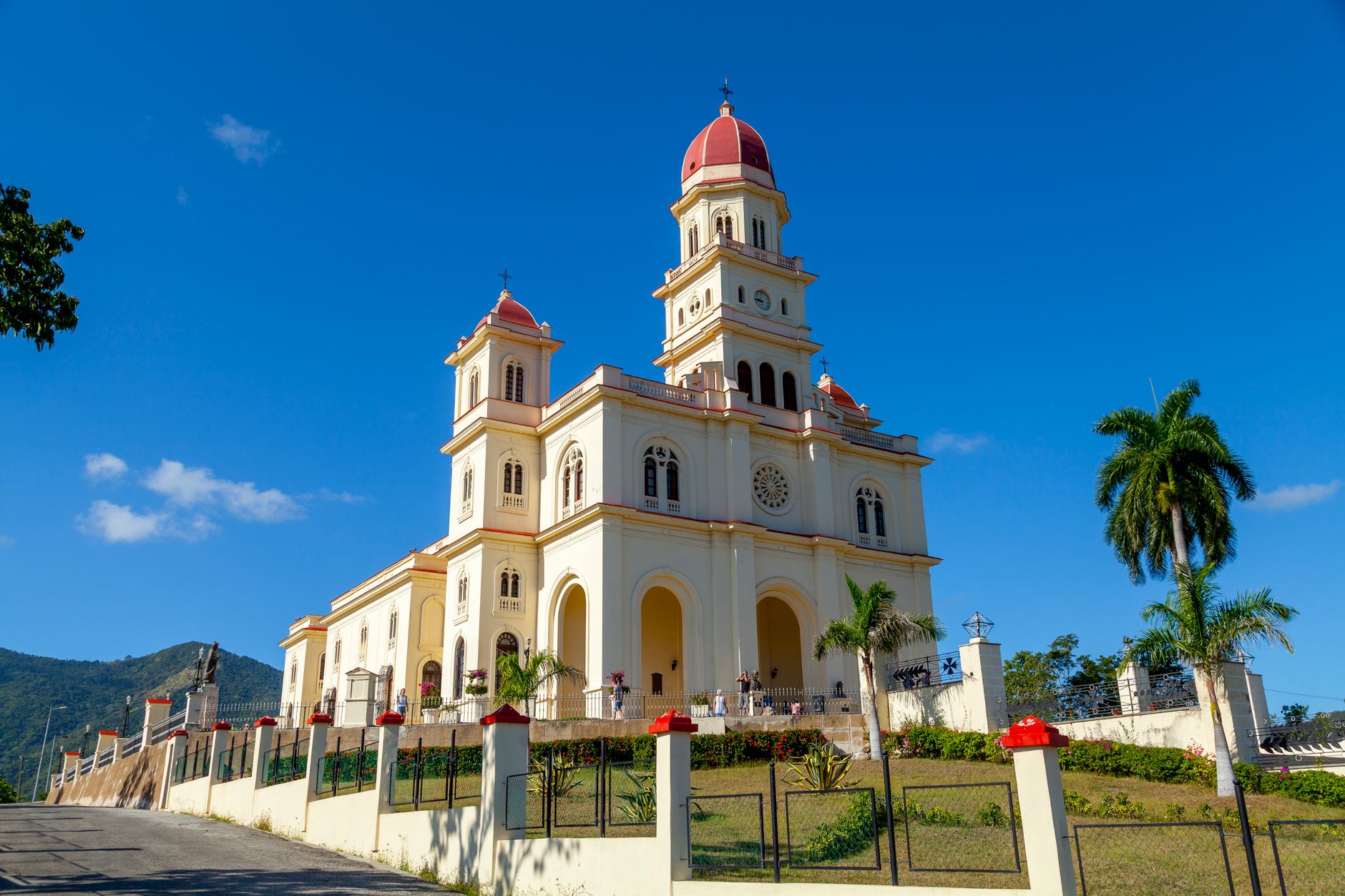
El Cobre is a small mining village in eastern Cuba, about twenty kilometers from Santiago de Cuba, which is home to the most important place of worship in all of Cuba: the Sanctuary of Our Lady of Charity of El Cobre, patron saint of the island. On a hill, with its silhouette of reddish domes set against the green mountains of the Sierra Maestra, the basilica is the spiritual heart of the country and the main pilgrimage center for Cubans, Catholics and Santería devotees alike.
The village was born around the copper mines that the Spanish exploited from the 17th century —hence its name (cobre means copper)—, worked largely by slaves. It was among those miners and the Black and mixed-race population that the devotion to 'Cachita', as the Virgin is affectionately called, took deepest root, a figure that over time merged with Ochún, the orisha of love and rivers in the Yoruba religion, becoming a symbol of Cuban identity and racial mixing.
This guide covers the essentials of El Cobre with a practical, respectful eye: the story of the Virgin's apparition and of the sanctuary, what to see in the basilica and its surroundings, what the pilgrimage is like, how to get there from Santiago de Cuba and what to keep in mind when visiting a place of profound religious significance. More than a conventional tourist destination, El Cobre is a place of faith, memory and syncretism that helps to understand the soul of Cuba.
The name El Cobre comes from the copper mines that the Spanish exploited in the area from the early 17th century, worked by African slaves. According to tradition, around 1612 three workers —the famous 'three Juans'— found a small image of the Virgin floating in the Bay of Nipe with the inscription 'I am the Virgin of Charity', an episode that gave rise to the national devotion. Over time a sanctuary was raised in El Cobre, today a basilica, which became the main pilgrimage center of Cuba. The Virgin of Charity of El Cobre was declared patron saint of Cuba in 1916 and canonically crowned in 1936; Pope Benedict XVI elevated the church to a minor basilica in 2012. In popular religiosity, 'Cachita' is syncretized with the orisha Ochún. The full history is on our history page.
Read the full history ↓The 'cradle of the Revolution' and capital of the Cuban Caribbean: the country's second city, its first colonial capital, birthplace of son, of carnival and of rum, with the World Heritage Morro castle and the shrine of El Cobre, home of Cuba's patron saint.
Read the history of Santiago de Cuba →A local guide tells you in half an hour what no sign at the site will ever explain. We look ours up on Civitatis: guided in Spanish and booked online with no fuss. They have 4 activities in Santiago De Cuba. And there are free tours here: you book without paying and tip the guide whatever you think at the end, so trying one costs you nothing. Have a look below: tap any of them to see them all.
They depart from Santiago De Cuba, 13 km away. Affiliate link: we earn a commission.
Abroad, getting sick is more than a bad day. In many destinations public healthcare depends on appointments, queues and availability, and private care is paid upfront. An emergency can cost thousands of USD, right when you are far from home and on a tight budget. That is why I recommend you never leave without travel assistance.
I recommend GO! Assistance because it covers what matters: medical care, emergencies, medication and hospitalization depending on the plan. It protects you 24 hours a day, anywhere in the world, with real-time solutions on the ground. GO! 365 ECO and GO! 365 give you USD 45,000 of global coverage: the first with a USD 100 deductible, the second with none.
If you quote from Argentina, in October GO! also offers 12 interest-free instalments on all its products.
GO! Assistance has 50% off in October and, with our link, you get an extra 20%.
Pick origin, destination, dates and ages and see the price of your travel assistance in a minute.
I have never been left without internet on a trip. I land and my phone connects to the strongest network in the country I am visiting: I can let people know I arrived, sort out transport, book tours and keep posting content at a super affordable price (really cheap!). I always use the Maya Mobile eSIM, check out its plans by clicking the banner. See Maya Mobile plans →
Affiliate link: we earn a commission.
No exact prices: a scale from $ (budget) to $$$$$ (luxury), with 2-3 options per category.
Origins, formation and what the sources say.
Almost a century before Cuba abolished slavery, in a mining village lost among the mountains of the east, a community of Black slaves achieved the unthinkable: their freedom. That village is El Cobre, and its history begins literally in its name (cobre means copper). The copper mines that the Spanish began to exploit here in the early 17th century were among the first of importance in the New World. Attracted by the rich deposits northwest of Santiago de Cuba, the colonizers set up an operation that soon depended, like almost the entire colonial economy, on the labor of African slaves brought for the hard work underground.
When the private operation entered a crisis and the Spanish crown took control of the mines toward the end of the 17th century, the copper slaves became property of the king: the so-called 'royal slaves' or 'cobreros'. This peculiar legal condition gave them, paradoxically, certain margins of autonomy —plots to farm, some community organization— and an extraordinarily strong collective identity, very different from that of the plantation slaves. Throughout the 17th and 18th centuries, the cobreros led resistances, escapes to the hills and prolonged legal battles for their freedom, in a process that Cuban historians consider one of the most singular chapters in the history of slavery in the Americas.
It was in this community of Black and mixed-race miners and slaves that the devotion to the Virgin of Charity took root, with extraordinary strength. The Virgin became their protector, the figure to whom they entrusted their sorrows, their dead and their yearnings for freedom. Thus, from its very foundations, El Cobre unites two inseparable histories: that of copper and slavery, and that of a faith that, over the centuries, would become the symbol of an entire nation.
The most extraordinary episode of this history broke out on July 24, 1731. Faced with the crown's attempt to sell the mines to private owners —which would have reduced the cobreros once again to the condition of plantation slaves—, the community rose up and retreated to the mountains east of Santiago de Cuba, in the hills surrounding the present-day village of El Cobre. Like the maroons of Jamaica, the miners resisted from the heights the repeated attempts of the authorities to subdue them, in what historians consider one of the most important slave protests in colonial Cuba.
The magnitude of that rebellion was recorded by historians like José Antonio Saco, who documented it in his monumental 'History of Slavery', and José Luciano Franco, who devoted an entire study to it. For the historian Pedro Deschamps Chapeaux it was, in a way, the first and triumphant protest of the Cuban working people, because a community of slaves, by dint of struggle and a resistance sustained over generations, ended up winning its freedom.
That conquest was sealed much later, by a royal decree of 1801, when the Spanish crown recognized the cobreros' right to freedom and land, declaring the copper slaves and their descendants free. It was almost eighty years before the general abolition of slavery in Cuba, decreed only in 1886. That is why El Cobre is remembered as the place 'where the end of slavery began' on the island. And it's no coincidence that it was precisely this community, hardened in resistance and hope, that turned the Virgin of Charity into its spiritual banner: the faith of the cobreros and their fight for freedom grew together, in the shade of the same hill.
The founding story of the devotion is placed around 1612 (the sources vary within the early 17th century). According to tradition, three workers set out in a boat across the Bay of Nipe, on the northern coast of the east, in search of salt. A storm surprised them and, when the sea calmed, they saw an object floating on the water: it was a small image of the Virgin Mary with the Child, fastened to a board with the inscription 'I am the Virgin of Charity'. The astonishing thing, the story said, was that the image was completely dry despite floating in the sea.
The three protagonists went down in history as 'the three Juans': two indigenous or mixed-race men and a Black slave boy, Juan Moreno, whose testimony, recorded decades later (in 1687), is the main documentary source of the episode. That composition —Indian, mixed-race and Black— has been interpreted as a perfect symbol of Cuban racial mixing, the country's three ethnic roots united before the image of the Virgin.
The image was taken to the area of the El Cobre mines, where a first hermitage was built for it. There, according to tradition, the Virgin showed her will to stay: the legend says she disappeared at night and reappeared wet, as if she went out to roam the hills, until it was decided to build her a sanctuary on top of the hill. Thus was born the cult that over the centuries would become the most important in Cuba.
The devotion to the Virgin of Charity grew throughout the colonial centuries and demanded ever larger churches. The primitive hermitage raised in the 17th century was followed by successive sanctuaries on the El Cobre hill, which were rebuilt and expanded as the influx of pilgrims coming from all over the east and, over time, from all over the island increased.
The church that today dominates the village, with its three reddish domes and its central tower, was finished around 1927, already in the republican era. Its silhouette, set against the green of the Sierra Maestra, became one of the most recognizable images of Cuba. Inside were arranged the main altar that houses the image of the 'Cachita' —placed so that it can be turned toward the faithful during celebrations— and the famous chapel of miracles, where the ex-votos accumulate.
The sanctuary gained ecclesiastical rank over the course of the 20th century. Its consolidation as a great national pilgrimage center accompanied the process by which the Virgin of Charity ceased to be a regional devotion and became the patron saint of all Cubans, a role sealed with her official proclamation and the growing attention of the Church hierarchy.
Over the centuries, the devotion to the Virgin of Charity of El Cobre overflowed the local sphere and became a national faith. A decisive milestone came in 1916, when, at the request of the veterans of the wars of independence, Pope Benedict XV proclaimed her patron saint of Cuba. In 1936 the image was canonically crowned. The sanctuary, expanded and rebuilt, acquired its current form of a basilica with three domes, presiding over the village from on high.
The figure of the 'Cachita' occupies a unique place in Cuban culture for its profoundly syncretic character. In Santería —the Afro-Cuban religion of Yoruba root—, the Virgin of Charity is identified with Ochún, the orisha of love, sweetness, rivers and gold, associated with the color yellow. That is why, for many Cubans, the devotion to 'Cachita' inseparably unites the Catholic and the African, in one of the clearest expressions of the island's spiritual mixing.
The El Cobre sanctuary has received illustrious pilgrims and several popes on their visits to Cuba: John Paul II crowned the image in 1998, and Benedict XVI distinguished it in 2012 with the category of minor basilica and offered a golden rose; Pope Francis also visited the sanctuary in 2015. Famous offerings have passed through it over time —such as Ernest Hemingway's Nobel medal— and the ex-votos of millions of anonymous faithful. Today El Cobre remains the spiritual heart of Cuba, a place where the history of slavery, popular faith, syncretism and national feeling intertwine at the feet of a small image venerated by an entire people, on and off the island.